
Technical SEO Analysis | A9 Algorithm & NLP Optimization | 950 words
Amazon is no longer just a search engine that matches keywords to products. Its A9 algorithm has evolved into a sophisticated ranking system built on Natural Language Processing, entity recognition, and behavioral signals. For authors, this shift changes everything about how books get discovered.
The gap between a listing that ranks and one that disappears into page three is not luck. It is architecture. Specifically, it is the kind of metadata architecture that professional publishing services for authors are trained to build.
Amazon's A9 algorithm processes each product listing through a semantic analysis layer. It does not simply scan for the presence of a keyword. It evaluates contextual relevance, entity salience, and conceptual coherence across the entire listing structure.
Natural Language Processing allows the algorithm to understand that a book described as a "gripping psychological suspense set in rural Scotland" is semantically connected to queries like "dark mystery novels" or "atmospheric British thrillers," even when those exact phrases never appear in the text.
This is the core of entity-based SEO. Entities are concepts, people, places, and themes that Amazon's knowledge graph recognizes as related. A listing optimized for entity salience does not stuff keywords. It maps semantically relevant concepts with surgical precision.
Executing this correctly requires an understanding of how Amazon's NLP layer weights different fields. The title carries a disproportionate entity-signal load. The subtitle anchors the thematic classification. The editorial description feeds the secondary semantic layer. Backend search terms serve as a hidden entity expansion mechanism.
Most authors manage none of these layers correctly in isolation, let alone in coordinated combination.
The metadata architecture of an Amazon book listing is more complex than it appears on the product page. There are eight distinct data fields Amazon ingests for ranking purposes. Each field has a different weight, character limit, and semantic function.
Book publishing services that specialize in Amazon optimization approach these fields as a structured data problem, not a creative writing task. Every character in a 250-character title field is evaluated for its contribution to semantic coverage and click-through signal.
BISAC category selection is another dimension that authors routinely underestimate. Amazon uses BISAC classifications as a primary entity-cluster signal. Selecting the wrong category does not just misplace a book in browsing. It actively confuses the semantic context Amazon builds around the listing, suppressing it in AI-driven recommendation surfaces like "Customers Also Bought" and "Inspired by Your Browsing."
The seven backend search term slots, each accepting 50 bytes, function as an entity expansion layer. Expert book publishing services populate these slots using a structured methodology: synonyms, related concepts, thematic adjacencies, and underserved long-tail queries that a target reader would use but a general author would never think to include.
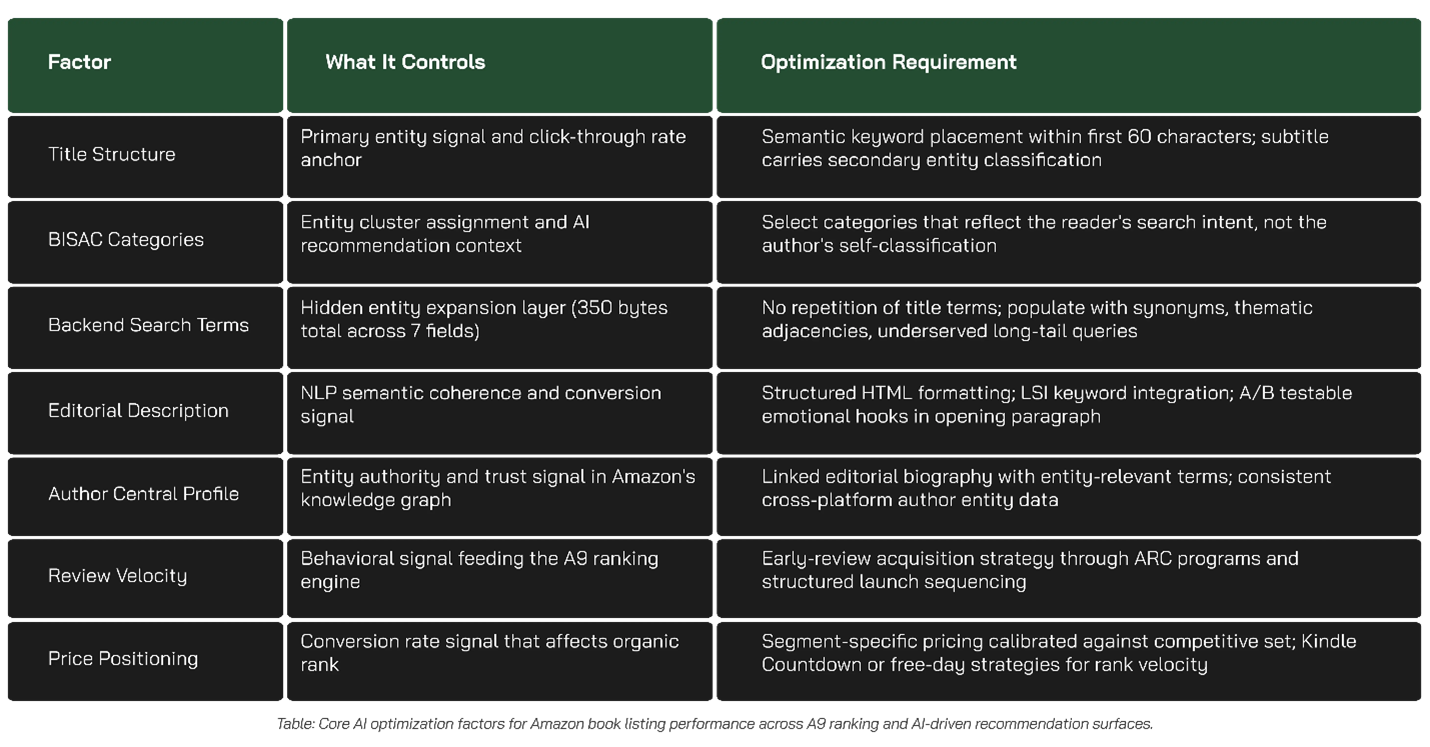
The table below summarizes the primary factors that determine how Amazon's AI search and recommendation systems evaluate a book listing. These factors apply across both keyword-based A9 ranking and the newer AI-driven discovery surfaces.
Amazon operates distinct storefronts across the United States, United Kingdom, Germany, Japan, Australia, and several other markets. Each storefront runs its own A9 instance with localized NLP training data.
A listing optimized for amazon.com will underperform on amazon.co.uk even when the content is written in English. The semantic entity clusters Amazon's NLP layer associates with genre terms differ between markets. A "cozy mystery" carries strong entity associations on the US storefront. The equivalent semantic cluster on the UK storefront responds to different terminology and thematic signals.
This is why global book publishing strategy cannot be reduced to republishing the same listing across marketplaces. Each market requires localized metadata architecture, including BISAC and BIC category alignment, localized backend search terms, and price positioning calibrated against the regional competitive set.
Global book publishing at scale also introduces a technical compliance dimension. Amazon's content guidelines vary by storefront. Backend search term policies differ. Restricted keywords that suppress listings on one marketplace may be neutral on another. Managing this across six to ten active storefronts simultaneously requires systematic knowledge that goes well beyond a single author's capacity to maintain.
Amazon has begun integrating generative AI into its shopping experience. The AI-powered search assistant, tested under the name "Rufus," retrieves product recommendations by processing natural language queries against a semantic index of listings. It does not return results based on keyword density. It retrieves listings that have strong entity coherence, high behavioral trust signals, and metadata that aligns with the conceptual intent of the query.
For book listings, this means that descriptions written as pure marketing copy will underperform relative to descriptions structured for NLP parsing. Short paragraphs. Declarative sentences. Thematic concept clustering in the opening lines. These are not stylistic preferences. They are structural signals that AI retrieval systems weight when assembling recommendations.
Publishing services for authors that have adapted to this environment write editorial descriptions that function simultaneously as conversion copy and as machine-readable entity documents. That dual function requires expertise in both disciplines at once.
The information above describes the "what." The challenge is the "how," and the "how" is where the complexity compounds.
Correct BISAC selection requires knowledge of Amazon's internal category taxonomy, not just the published BISAC standards. Backend search term optimization requires access to keyword demand data, competitive gap analysis, and an understanding of Amazon's duplicate-suppression logic. Localized global book publishing requires ongoing monitoring of policy changes across multiple storefronts. And AI-optimized description writing requires NLP-aware copywriting skills that most marketing professionals have not yet developed.
Each of these tasks is manageable in isolation. In combination, across multiple titles, multiple formats, and multiple storefronts, the operational overhead exceeds what any individual author can reasonably absorb alongside the actual work of writing.
Publishing services for authors exist precisely because the distance between knowing the strategy and executing it correctly is substantial. The frameworks described here represent the minimum viable knowledge base. Applying them at a level that generates measurable ranking lift requires specialized tooling, current platform intelligence, and iterative testing across real listings. That combination is what separates authors who appear in Amazon search from those who do not.
